
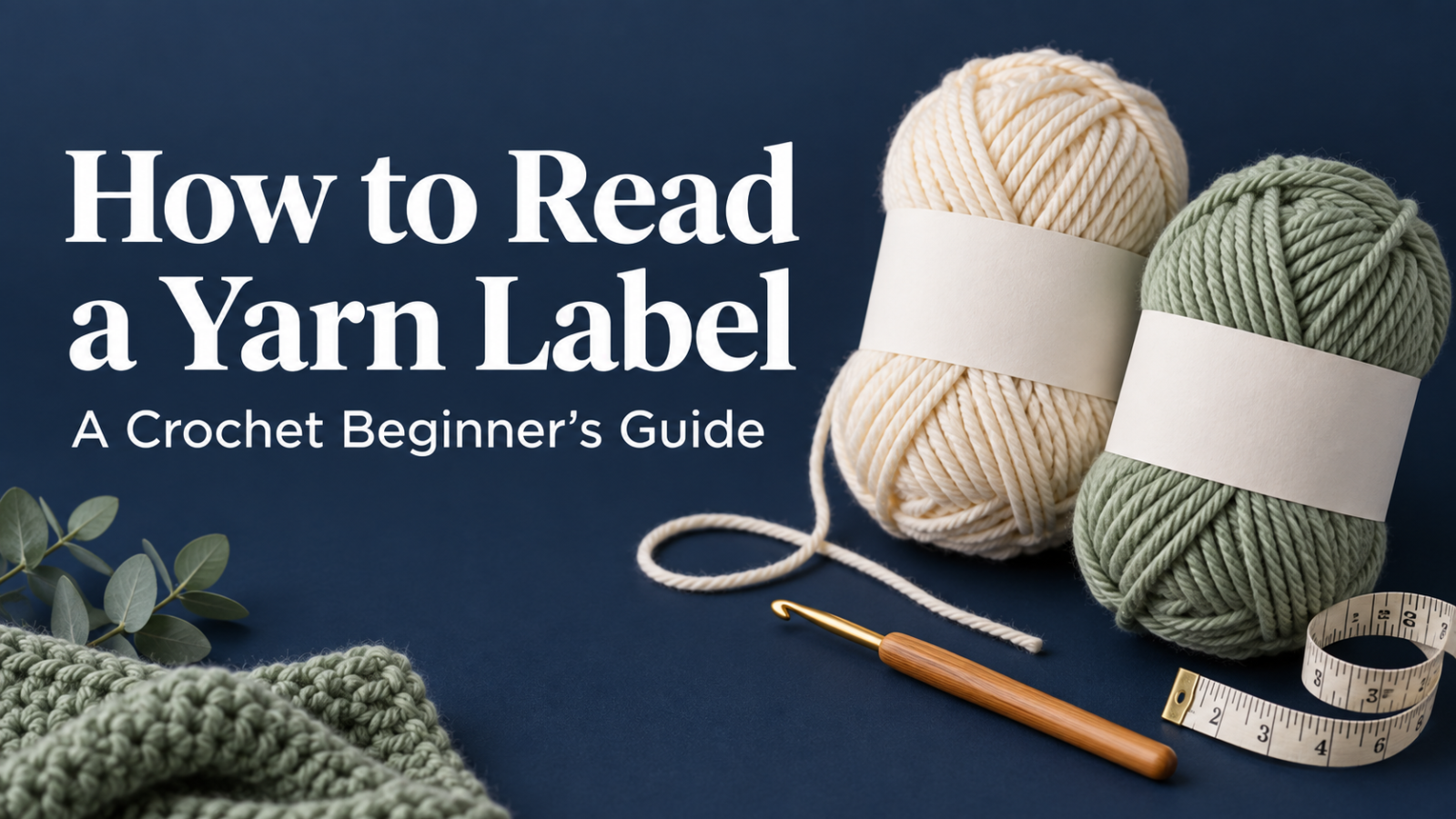
A yarn label is a small reference card for your next crochet project. It can help you check whether a yarn matches a pattern, calculate how much to buy and care for the finished piece. You do not have to understand every symbol at once: start with the thickness, length and fibre information.
This guide explains how to read a yarn label in a practical order. Keep your pattern beside the label so you can compare the two before choosing a colour.
1. Separate yarn thickness from the weight of the ball
Two different meanings of “weight” can appear on one label. A category such as 4 Medium describes thickness. A measurement such as 100 g tells you the mass of the yarn in that ball. A 100 g ball is not automatically thicker than a 50 g ball.
The Craft Yarn Council’s standard yarn weight system uses these categories. Names used by brands and countries can vary, so compare the complete label with your pattern.
| Number | Category |
|---|---|
| 0 | Lace |
| 1 | Super Fine |
| 2 | Fine |
| 3 | Light |
| 4 | Medium |
| 5 | Bulky |
| 6 | Super Bulky |
| 7 | Jumbo |
A category helps you narrow your choices, but it is not a promise that two yarns will behave identically. For a first project, choosing the yarn specified in the pattern removes one source of uncertainty.
2. Find the length in metres or yards
Look for m or yd: these describe the length of yarn in a ball. Lion Brand confirms that yardage is listed on its yarn labels and product descriptions. When comparing yarns, check this figure as well as the grams.
Use the same unit throughout your calculation. If a pattern needs 550 metres and your chosen suitable yarn contains 200 metres per ball, divide 550 by 200. The result is 2.75, so round up to 3 whole balls. That gives you 600 metres.
This calculation only converts a stated length into balls. It does not establish that a substitute yarn is suitable, and it does not guarantee the pattern estimate will cover changes to size, stitch pattern or tension. Check whether the pattern’s allowance includes swatching, then plan any additional yarn accordingly.
Do not replace “three balls” with three balls of a different yarn without checking their lengths. A ball containing 120 metres and one containing 200 metres are not equivalent quantities, even if both weigh 100 g.
3. Read the crochet hook recommendation
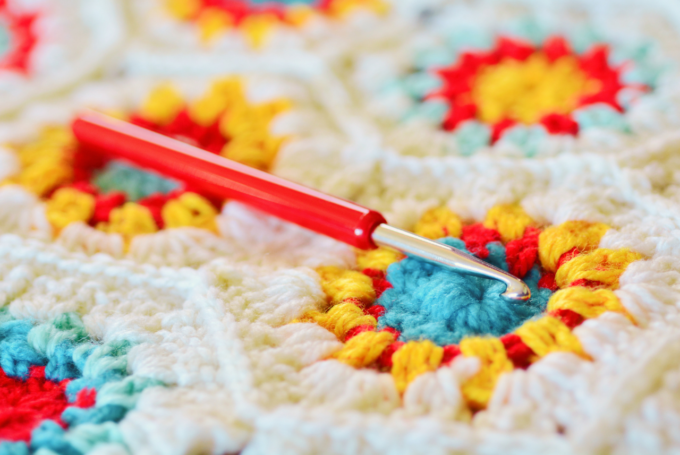
A label may show knitting needles, a crochet hook, or both. Make sure you are reading the crochet information. Note the size in millimetres when provided, rather than relying only on a letter or number.
The label’s suggested hook is a starting point. Your pattern may intentionally specify a different size to create a different fabric. Use the pattern’s hook recommendation for your first swatch and evaluate the result before beginning the main project.
The gauge box needs its context
Gauge describes how many stitches and rows fit within a stated measurement. Read the measurement, stitch and tool information together. A knitting gauge box is not a crochet gauge target, and a label’s sample is not necessarily the same stitch pattern as your project.
For a project with a gauge requirement, follow the pattern’s swatch directions, including any washing or blocking instructions, then compare your measurements with its target. Do not start a fitted project simply because the hook number matches the label. If written instructions still feel unfamiliar, read our guide to following a crochet pattern.
4. Check fibre content, care and colour details
Fibre content
Read the complete fibre list and percentages. “Cotton blend” does not mean the same thing as “100% cotton.” Compare the composition with the pattern recommendation and the intended use of the finished piece. If substituting, assess the feel and behaviour of a swatch instead of assuming that a matching weight category settles the question.
Washing and drying instructions
Read the written care directions and any symbols before buying. Washing and drying are separate steps: permission to machine wash does not automatically mean permission to tumble dry. If a symbol is unclear, check the yarn manufacturer’s care guide, such as Lion Brand’s yarn label and care reference, rather than guessing.
Keep the label with your project notes. When giving the finished item as a gift, include the applicable care instructions so the recipient does not have to identify the yarn later.
Colour name and dye lot
A colour name identifies the shade; a dye lot identifies a dyeing batch. When using several balls of one colour, compare both. Lion Brand explains dye lots here. Where a lot number is provided, buying enough matching balls together can help avoid an unexpected shade change. Also inspect the balls in consistent light.
5. Practise with an imaginary label
The following numbers are a fictional teaching example, not a product recommendation or a universal combination of specifications.
- Category: 4 Medium
- Ball mass: 100 g
- Length: 200 m
- Fibre: 100% acrylic
- Suggested crochet hook: 5.5 mm
- Colour: Meadow
- Dye lot: A217
You would read this as a medium-category yarn with 200 metres in each 100 g ball. The 5.5 mm hook is a suggested starting point, not an instruction that overrides every pattern. You would still need to read this yarn’s care information and compare it with your project requirements.
If your selected pattern required 550 metres of this exact yarn, the earlier calculation would suggest three balls before any additional allowance you decide is needed. Check that all three carry the intended colour and matching lot information.
Your before-you-buy checklist
- Open the pattern’s materials list and select the size you intend to make.
- Compare the recommended yarn with the label’s category and fibre content.
- Check metres or yards per ball and calculate the number of whole balls.
- Find the crochet hook information and compare it with the pattern.
- Read the pattern’s gauge and swatch instructions.
- Check washing and drying directions.
- Compare colour names and dye lots across the balls.
- Photograph or save a label with your project notes.
Give yourself a short pause before checkout: can you explain what the main numbers mean? If not, look up the manufacturer’s description or ask the yarn shop to help identify the missing information.
Frequently asked questions
Does 100 g tell me how thick the yarn is?
No. It is the ball’s mass. Look separately for the yarn category and compare the yarn with your pattern.
Can I use any yarn with the same category number?
That number is a useful first check. Fibre, construction and the fabric you produce also matter. Follow your pattern’s substitution guidance and make a swatch before committing to a project.
What if there is no crochet hook size?
Check the manufacturer’s product page and your pattern. Do not read a knitting needle recommendation as if it were automatically a crochet hook instruction.
What if my yarn has no label?
Keep it for practice until you can identify its details. Avoid promising a particular fibre content or care method without reliable information. For a project where fit or care matters, labelled yarn makes planning easier.
Choose your next crochet project
Continue with our beginner crochet guides to build your skills. When you are ready to explore another project, browse crochet patterns at CrochetPatternly. The shop link is for browsing patterns; it is not a physical crochet kit or a promised free PDF.



Leave a comment